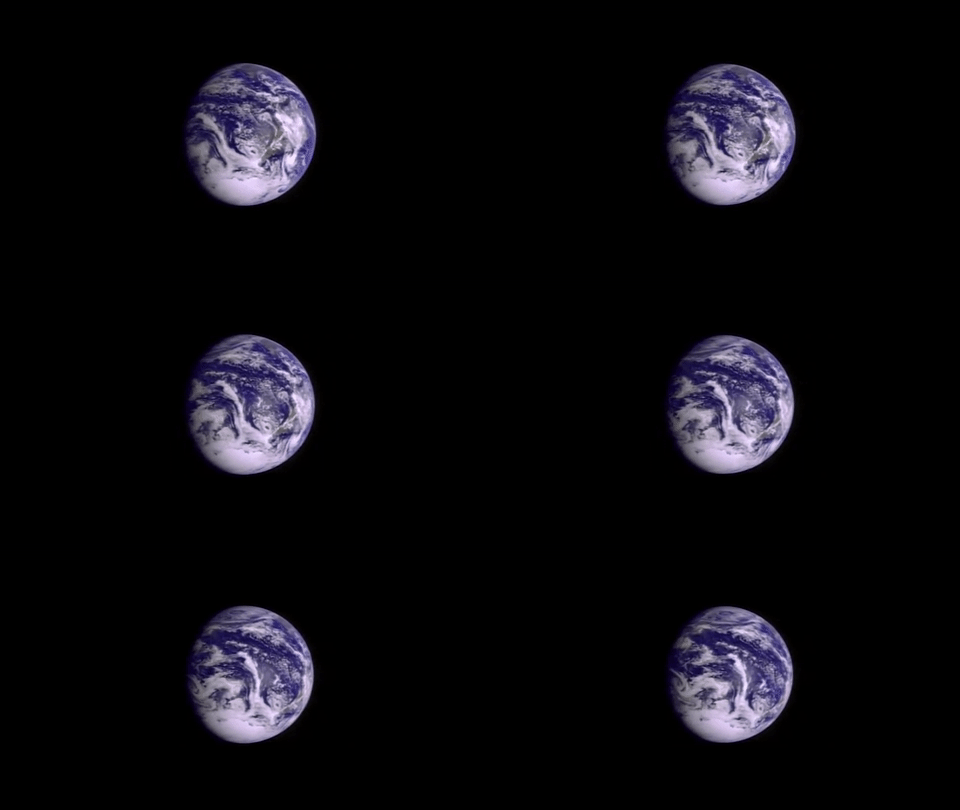
Here’s the orbital period of our solar system’s 8 major planets (how long it takes each to travel around the sun). Their size is to scale and their speed is accurate relative to Earth’s. The repetition of each GIF is proportional to their orbital period. Mercury takes less than 3 months to zoom around Sol, Neptune takes nearly 165 years.
fuck this gifset do you know how long i sat here waiting for fucking neptune to drag its lazy ass into the frame
Earth, our home planet, is the fifth largest planet in our solar system and the only planet we know of where life exists. Even though Earth seems extremely large to us, it is actually a tiny spec in the vast expanse of the universe. Here are 7 space facts that will make you feel very small.
1. Our sun is one of at least 100 BILLION stars, just in the Milky Way. Scientists calculate that there are at least 100 billion galaxies in the observable universe, each one brimming with stars. There are more stars than grains of sand on all of Earth’s beaches combined.
In 1995, the first planet beyond our solar system was discovered. Now, thousands of planets orbiting sun-like stars have been discovered, also known as exoplanets.
2. The Milky Way is a huge city of stars, so big that even at the speed of light (which is fast!), it would take 100,000 years to travel across it.
3. Roughly 70% of the universe is made of dark energy. Dark matter makes up about 25%. The rest — everything on Earth, everything ever observed with all of our instruments, all normal matter adds up to less than 5% of the universe.
4. If the sun were as tall as a typical front door, Earth would be the size of a nickel.
5. The sun accounts for almost all of the mass in our solar system. Leaving .2% for all the planets and everything else.
6. Edwin Hubble discovered that the Universe is expanding and that at one point in time (14 billion years ago) the universe was all collected in just one point of space.
7. Four American spacecraft are headed out of our solar system to what scientists call interstellar space. Voyager 1 is the farthest out — more than 11 billion miles from our sun. It was the first manmade object to leave our solar system. Voyager 2, is speeding along at more than 39,000 mph, but will still take more than 296,000 years to pass Sirius, the brightest star in our night sky.
This image, captured with the NASA/ESA Hubble Space Telescope, is the largest and sharpest image ever taken of the Andromeda galaxy — otherwise known as M31.
This is a cropped version of the full image and has 1.5 billion pixels. You would need more than 600 HD television screens to display the whole image.
It is the biggest Hubble image ever released and shows over 100 million stars and thousands of star clusters embedded in a section of the galaxy’s pancake-shaped disc stretching across over 40 000 light-years.
OH NOOOO I AM SLAIN LOOK AT THAT SPACEY SPACE WHAAAAT I NEED A MOMENT
Today I cried in a planetarium. Space does weird things to my emotions.




 iampinbitch